How Community Shark Bite Kits are saving lives on Australian beaches

A few minutes can decide whether a shark attack becomes a tragedy or a survival story.
That reality sits at the heart of Community Shark Bite Kits, a grassroots initiative that aims to place lifesaving bleeding control equipment within easy reach of surfers, swimmers, anglers, and anyone else who spends time by the ocean.
The project was founded by Australian surfer Danny Schouten after witnessing how close his friend Kai McKenzie came to dying in a shark attack.
Today, the movement has grown into a nationwide campaign that has already helped save lives.
Here’s how it works.
A friend’s survival sparked the idea
The story begins in July 2024 at North Shore Beach in Port Macquarie, New South Wales.
Twenty-three-year-old surfer Kai McKenzie was attacked by a shark estimated at around nine feet (three meters) long.
The shark severed his right leg.
McKenzie managed to get back to shore after fighting off the animal, but his survival depended on what happened next.
A retired police officer used his dog’s leash as a makeshift tourniquet to slow the massive blood loss.
For Schouten, the incident exposed a troubling gap in beach safety.
Tourniquets and trauma equipment existed, but they were often locked away in surf clubs, emergency facilities, or private vehicles.
In a major bleeding emergency, precious time could be lost simply trying to find the equipment.
“It was by the grace of a man… walking his dog on the beach that day, who was trained in trauma control and used his dog lead to save Kai’s life,” Schouten later told 9News.
“And I thought, we need to have one of these kits on every one of our beaches so it’s not left up to chance next time.”
That experience led to the creation of Community Shark Bite Kits, shortened to Community SBK.
The non-profit initiative focuses on one goal: making emergency bleeding control equipment publicly accessible on Australian beaches.

What is a Community Shark Bite Kit?
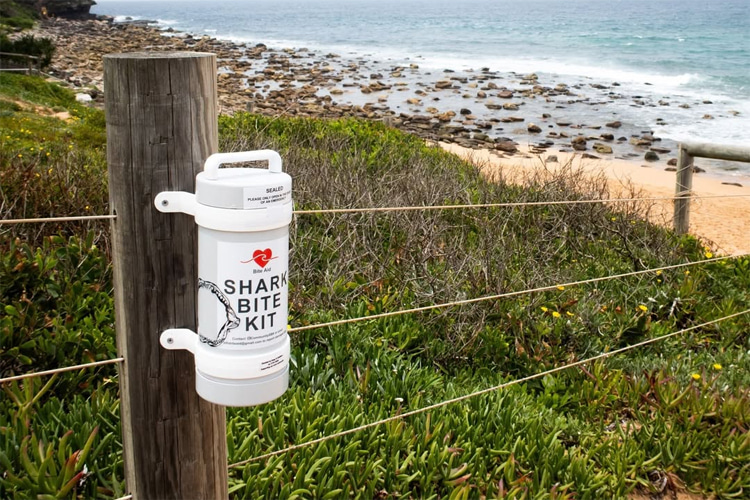
Community Shark Bite Kits are highly visible emergency response kits designed to help people control catastrophic bleeding during the critical minutes before paramedics arrive.
They are intended to be simple enough for ordinary bystanders to use.
The kits are typically mounted at busy surf beaches, attached to emergency infrastructure, or positioned in locations where ocean users can quickly access them.
The idea is straightforward.
If someone suffers a severe shark bite injury, the equipment is already there. There’s no waiting, no searching, no improvising with whatever happens to be nearby.
As Schouten has explained, people can lose a dangerous amount of blood within minutes after a major shark bite.
Fast action can make the difference between life and death.
What’s inside the kits?
The contents vary slightly between installations, but each kit is built around severe bleeding control.
Most Community SBKs contain tourniquets, large trauma dressings, compression or conforming bandages, gloves, an emergency thermal blanket, a whistle, and simple step-by-step treatment instructions.
Some versions also include amputated limb bags designed to help preserve severed body parts for medical treatment.
The instructions are intentionally easy to follow.
Schouten has repeatedly emphasized that the kits are designed so that everyday beachgoers can help even if they have no medical background.
A community-funded national rollout
What began as a local response to one devastating attack quickly spread beyond Port Macquarie.
CommunitySBK relies heavily on donations and community support.
Funds help pay for manufacturing, supplying, installing, maintaining, and replacing kits, while also supporting public education about emergency bleeding control.
The initiative has received support through GoFundMe campaigns and local fundraising efforts.
The first installations appeared on beaches in northern New South Wales. Within a year, the network had expanded dramatically.
Reports published in late 2025 stated that more than 150 kits had already been installed across New South Wales, Queensland, South Australia, and Western Australia.
The numbers have continued to grow.
In June 2026, Schouten said almost 250 kits had been installed across New South Wales and Western Australia.
Local councils and surfing organizations have also joined the effort.
In Randwick, Sydney, shark bite kits were installed at Coogee and Maroubra beaches to improve safety during periods when lifeguards are not on duty.
The day a kit helped save a life
The strongest argument for the program arrived on a winter day at Coogee Beach in Sydney.
In June 2026, 35-year-old Leah Stewart was seriously injured in a great white shark attack while swimming at Coogee Beach.
Witnesses watched as off-duty responders and bystanders rushed into action.
Emergency physician Dr. Ian Ferguson retrieved a nearby shark bite kit along with a defibrillator and immediately began treatment.
The kit had only been installed at Coogee a few months earlier.
According to reports, the tourniquet and other trauma equipment were used to help control Stewart’s severe bleeding until further medical care arrived.
She survived the attack and was transported to the hospital in critical but stable condition.
The event provided proof that public access to bleeding control equipment can have a real impact when every second matters.
Schouten later pointed to the Coogee rescue as an example of how rapid action, combined with nearby equipment and willing bystanders, can change the outcome of a catastrophic injury.